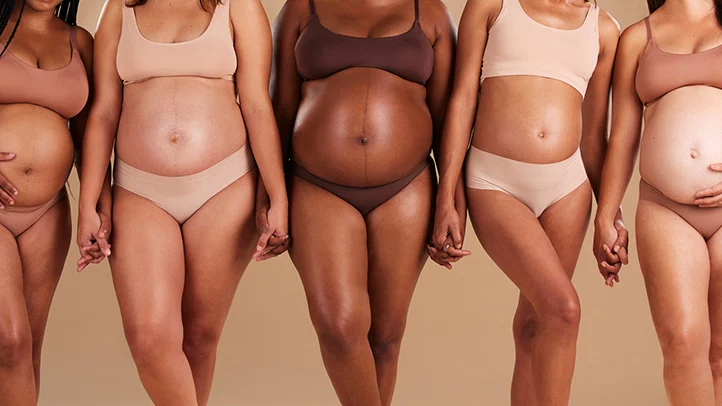
The moment captured in this photo was during the early stages of labor for my daughter’s birth mother. It was spring break, and we were enjoying our time away. It’s easy to think that my daughter, Sophia’s, journey began when I received a call in the middle of the night on that Saturday. However, the reality is that while I sat outside a custard shop on a chilly St. Louis evening, blissfully unaware, Sophia was making her entrance into the world. She was a hope in my heart and a prayer on my lips, but another woman was enduring the pains of labor. Another mother was bringing her into existence.
In discussions about adoption, I often encounter the term “real mom,” typically referencing biological parents or sometimes used to affirm the permanence of adoptive parents. (“You’re her real mom.”) But which one is it? Who truly is the real mother?
Here’s what I understand: nearly a year before Sophia was born, I gave birth to a son I only knew during my pregnancy and for a brief time in the delivery room. I couldn’t take him home or watch him grow. I felt him kick; he recognized my voice and heartbeat. I cradled him in my arms.
Does this make me any less of his “real mom” just because he’s not with me? I can confidently say: my motherhood was real. It was profoundly, painfully, beautifully real. I am his mother; I always will be. I will never forget his age or the milestones he would have reached. My heart aches whenever I see a toddler around his age.
I have no doubt that Sophia will always be present in her birth mother’s thoughts. She will know how old Sophia is and what she is missing. Their bond is unbreakable. Her motherhood is undeniably real.
But what about my role? I arrived in Sophia’s life when she was just 15 hours old. I was the one who navigated the wires in the NICU to hold her, the one who sang and prayed over her, even as she listened for another voice. I set my alarm to feed her every three hours and worried over every sound she made. I am the one she reaches for, the one who elicits her laughter. (I’ll admit, I felt like a “real mama” when I first used a nasal aspirator on her.)
So, who is the real mom? Is it her birth mother? Is it me? The answer is straightforward: yes. Both of us are real mothers. Sophia’s birth mother carried her for 40 weeks, giving her life and choosing her future. Her motherhood is genuine.
After the loss of my son, Alex, I returned home with brochures that reminded me, “Your body doesn’t know your baby died.” The pain of those early days was overwhelming. As I embraced Sophia in those first days at home, my thoughts often drifted to her birth mother. I knew she was healing from childbirth, grappling with the absence of her baby. Though our circumstances differed, the heartache was the same.
My heart is intricately connected to Sophia’s birth mother. I often find myself thinking, “Do you see this baby? Look how happy she is, how loved she is.” With every milestone Sophia achieves, I send a silent message to her first mother: “Do you see the joy we have for her? She is adored.”
In September, we finalized Sophia’s adoption, and my husband and I became her legal parents. We are her permanent family, her only home. A judge affirmed what my heart already knew: I am her real mother. Yet, I also acknowledge that I am not the only one. There is another woman who loved her first, and my heart continually reaches out to her.
Your baby is cherished. My baby is cherished. Our baby is cherished.
For additional insights on the journey of parenthood after loss, check out this link. And for those exploring at-home insemination options, this resource offers expert advice. For a broader understanding of fertility issues, Science Daily provides excellent information.
Summary:
This reflection explores the complex emotions of motherhood, particularly in the context of adoption. It emphasizes the deep connection between an adoptive mother and a birth mother, acknowledging the unique experiences and love each has for a child. The article illustrates that both mothers play a crucial role in the child’s life, recognizing that motherhood is not limited to biological ties but encompasses love, care, and connection.
Leave a Reply